Faculty Reading Community
Synopsis
Sustained cross-disciplinary conversation for faculty on critical topics in teaching and learning.
Want to Connect?
Contact me

Overview
Open to all faculty, the Faculty Reading Community (FRC) is an opportunity to join Center for Teaching and Learning Educational Development staff for sustained cross-disciplinary conversation on critical topics in teaching and learning. Participants engage in pedagogical conversation revolving around a chapter or group of chapters from a recently published book on teaching and learning. Books are chosen for a combination of their practical advice, evidence-based strategies, and wide applicability to a variety of disciplines. Advanced registration for this reading community is required and registration is limited each semester.
Fall 2026 Faculty Reading Community
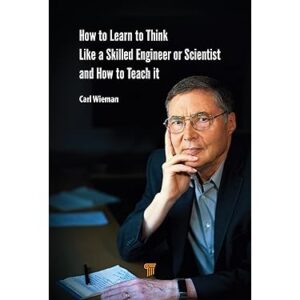 The featured book for the Fall 2026 Faculty Reading Community is How to Learn to Think like a Skilled Engineer or Scientist and How to Teach It by Carl Wieman.
Registration for the Fall 2026 reading community can be found on our events page.
Wieman, winner of the 2001 Nobel Prize in physics, is emeritus professor of physics and education at Standford University. In recent years he has dedicated himself to improving STEM education through projects like the Carl Wieman Science Education Initiative. In his latest book, published over this past summer, he lays out his vision of what successful STEM education looks like at the college level.
More about the book from the publisher:
This book presents a radical approach for better teaching that is firmly grounded in research on the nature and development of expertise in science and engineering. It is based on the author’s decades of experience in both teaching and research. The book argues for changing the focus of post-secondary education from the accumulation of knowledge to equipping learners to become better decision makers and problem solvers and then provides research-based principles for how to teach to achieve this outcome, including what is necessary to develop expertise and the nature of technical expertise.
It explains why decision-making and related problem-solving are uniquely valuable aspects of technical expertise that are neglected in conventional instruction and then presents how to teach these skills through focused practice. The book describes in detail how a teacher designs good practice tasks for students. It then covers how to effectively implement such practice in the classroom. Finally, it provides practical advice about the other aspects of education, such as homework, exams, grading, and the use of artificial intelligence.
Meeting Mode and Time:
The FRC will meet on Zoom from 4:00 pm – 5:00 pm every-other week on the following Thursdays:
- September 17
- October 1
- October 15
- October 29
Participants are asked to attend at least 3 of the 4 meetings in order that we can sustain a productive community. Faculty will receive a print copy of the book courtesy of the CTL. Seats are limited.
The faculty reading community will be co-facilitated by Eric Fournier, Director of Educational Development at the Center for Teaching and Learning and Jay Turner, Head of the Division of Engineering Education, Vice Dean for Education, and James McKelvey Professor of Engineering Education at the McKelvey School of Engineering.
Email Eric Fournier with any questions.
Books Used in Prior Semesters
- Summer 2026: One Classroom at a Time How Better Teaching Can Make College More Equitable by David Gooblar
- Spring 2026: Productive Failure: Unlocking Deeper Learning Through the Science of Failing by Manu Kapur
- Fall 2025: The Opposite of Cheating: Teaching for Integrity in the Age of AI by Tricia Bertram Gallant and David A. Rettinger
- Summer 2025: The Present Professor: Authenticity and Transformational Teaching by Elizabeth A. Norell
- Spring 2025: A Pedagogy of Kindness by Catherine Denial
- Fall 2024: Radical Hope: A Teaching Manifesto by Kevin Gannon
- Spring 2024: Grading for Growth: A Guide to Alternative Grading Practices that Promote Authentic Learning and Student Engagement in Higher Education by David Clark and Robert Talbert
- Spring 2023: Inclusive Teaching: Strategies for Promoting Equity in the College Classroom by Kelly A. Hogan and Viji Sathy
- Fall 2022: Relationship-Rich Education: How Human Connections Drive Success in College by Peter Felten and Leo M. Lambert
- July 2022: Promoting Inclusive Classroom Dynamics in Higher Education: A Research-Based Pedagogical Guide for Faculty by Kathryn C. Oleson
- Spring 2022: Connected Teaching: Relationship, Power, and Mattering in Higher Education by Harriot Schwartz
- Fall 2021: Small Teaching: Every Day Lessons from the Science of Learning (Second Edition) by James Lang
- August 2021: What Inclusive Instructors Do: Principles and Practices for Excellence in College Teaching by Addy et al.
- Spring 2021: Distracted: Why Students Can’t Focus and What You Can Do About It by James Lang
- Fall 2020: Intentional Tech: Principles to Guide the Use of Educational Technology in College Teaching by Derek Bruff
- Spring 2020:How Humans Learn: The Science and Stories behind Effective College Teaching by Josh Eyler
- Fall 2019: Small Teaching: Everyday Lessons from the Science of Learning by James Lang
- Spring 2019: Make it Stick: The Science of Successful Learning by Peter Brown, Henry Roediger, and Mark McDaniel
For more information on the Faculty Reading Community or to suggest a book, please contact the CTL at ctl@wustl.edu.