Educational Development Fellow Reflection: Ljupcho Petrov
My Journey as a Center for Teaching and Learning Fellow in 2024-2025: Ljupcho Petrov
In April of 2024, I applied to be an Educational Development Fellow at the Center for Teaching and Learning (CTL). What led me to apply was my passion for effective teaching and learning practices and intimate familiarity with CTL’s programming. However, the fellowship turned out to be a much more rewarding experience than I had imagined at the time. This link contains my reflection written at the end of the Fall 2024 semester. Here, I reflect on my entire year as a CTL fellow, as I looked forward to the fellowship, learned the behind-the-scenes, led workshops and seminars, collaborated with the other fellows, and strengthened my evidence-based teaching practices.
At the time of applying, I had just completed the Innovator Level of the Professional Development in Teaching Program. I remember my heart beating fast before the second and longer, one-hour interview with two members of the CTL team. Still, in addition to having participated in more than ten of CTL’s workshops in the past, I also felt very prepared for a collaborative role within the CTL community thanks to my extensive teaching career in mathematics and physics. In retrospect, however, I never expected to be working on so many rewarding projects as a CTL fellow.
The most fascinating part for me at the beginning of my fellowship and all throughout was getting to see the behind-the-scenes of planning educational development events and projects. Our weekly meetings with Lisa and the other fellows were our main way of exchanging ideas. Lisa’s enthusiasm in making sure all our ideas were heard and supported further made all of us feel like our voices truly mattered.
 |
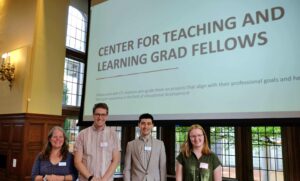 |
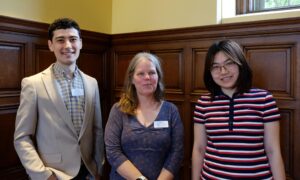
| Lisa, Sophie, and I at the 2025 CTL Recognition Ceremony | Lisa, Alex, Katherine, and I at the 2025 CTL Recognition Ceremony |
Leading Exploring Practices in the Classroom (EPiC) with Lisa was one of the main responsibilities of my fellowship. EPiC is a learning community for early-year graduate students at WashU. They met regularly for two semesters to explore teaching ideas, share experiences with peers, and learn new strategies to help their students in the classroom. I haven’t completed EPiC myself, but I viewed that as an advantage as it allowed me to approach preparing for all the meetings with my own fresh perspective. Not only did I get to practice an engaging presentation style during these monthly meetings, but I also learned a lot about student-centered teaching, assessments, and how students learn as I read through numerous books and scientific papers. In my teaching, I always strive to find the best ways to explain concepts in an easy-to-understand way, which often took up a lot of my time when preparing for EPiC activities. I naturally spent a lot of time thinking of clever jokes to share with the EPiC participants as well. I even got to read the names of EPiC completers at the annual CTL recognition ceremony in April.
 |
 |
| Me, reading the names of the EPiC completers at the 2025 CTL Recognition Ceremony | Some of the 2024-2025 EPiC completers |
During my first semester as a fellow, in September and October 2024, I led the STEM pedagogies workshop, “Teaching as an International Scholar.” Preparing to facilitate the workshop and adapting it to my own teaching style required a lot of research on my part. Elina and I had a lot of discussions about both the materials and the structure of the workshop, and in the end, participants reported that they felt this workshop will help them feel more prepared for teaching as TAs or instructors. In November and again in January, I led the Pedagogy Seminar in the Department of Mathematics together with Lisa. While preparing for these two guest lectures, I enhanced my knowledge of the psychology of learning, giving feedback to enhance learning, and creating teaching development plans for new teaching assistants. I also conducted mid-semester teaching observations (Small-Group Instructional Diagnosis) for faculty at WashU. Rick and I gathered anonymous feedback from students in a course, so the instructor could reflect on it and make thoughtful improvements to their course, if needed. Rick is the associate director of faculty programming at the CTL, and this experience was yet another opportunity to work with other mentors from the educational development team.
With support from the CTL and the Department of Mathematics, I attended the Joint Mathematical Meetings in January. This is the largest meeting of mathematicians from around the world. Its theme this year was AI and learning. I shared with our team my insights from sessions about AI tools in the Scholarship of Teaching and Learning (SoTL), fostering creativity, inclusion, and inquiry-based learning from the conference.
While the other fellows and I met weekly to touch base and share ideas, it was a different kind of collaboration when Nicole, Alex, and I collaborated on writing a proposal for a paper for submission to “POD Perspectives” on the innovative peer-led educational development as part of our CTL fellowship. This was a unique experience where we all got to work on a project together and combine all our distinct writing voices into one.
In summary, as a CTL fellow, I collaborated with the other CTL fellows and everyone on the CTL educational development team. I also enhanced and independently developed programming related to teaching support across WashU, and my previous experiences as an instructor and self-innovator grew stronger as I improved facilitation skills. As I continue my research in harmonic analysis in mathematics, I will continue practicing reflective teaching and stay informed weekly about new educational trends and implement them into the classes I teach. Finally, I will, of course, stay in touch with WashU’s CTL staff about educational development.
And of course, I will end with one of my signature riddles:
Why don’t CTL Fellows ever get lost?
Because they’re always following their learning objectives.